


28 April 2025
Invisible systems: What public transport can teach us about healthcare
I really love good public transport. It represents everything I value in a system: efficiency, connectivity and a sense of shared experience. When public transport works well, you don’t think about the mechanics of how the buses, trams and trains are timed or the engineering behind it all. You simply move through your day, trusting that the system will get you where you need to go. It’s kind of invisible, but always there when you need it.
Now, think about healthcare. It’s often quite the opposite: complex, fragmented and full of barriers. The experience can be overwhelming, especially for those most vulnerable. But what if healthcare operated like a well-designed transport system? A system that meets you where you are, as effortlessly as crossing the platform to catch the connecting train.
Maps that guide, not confuse
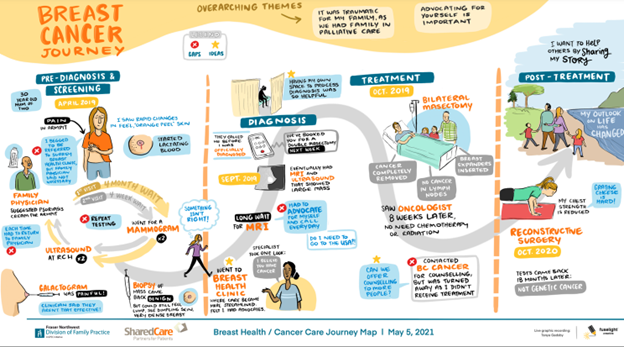
One of the most useful features of any good transport system is the map. Whether you're a daily commuter or a first-time visitor, the map shows you exactly how to get from point A to B. But in healthcare, there’s often no clear map, no obvious way to navigate the system. Each patient’s path can feel uncertain and filled with questions: Where do I go? What’s covered? Who do I call?
Caption: Visual representation of one individual's journey diagnosed with breast cancer, illustrating key stages and healthcare interactions. This map was created by Tanya Gadasby (in collaboration with the Divisions of Family Practice, Canada). Consider how a similar map could transform the way we navigate healthcare, making the journey clearer and more accessible for all.
It’s worth imagining how health systems might benefit from something similar: an intuitive guide that shows you different paths to things like care providers, insurance, financial assistance and specialised options. Like a transport map, it could use simple symbols and markers to summarise the options. This could take the form of a digital or physical tool available at clinics, on health apps or as part of an onboarding process when moving to a new area or country. Such a map could take healthcare from seeming like a maze to something clear and easy to navigate.
Omnichannel healthcare: Multiple routes, one destination
A key feature of a well-designed transport system is that it’s omnichannel. Whether you buy a ticket from a machine, tap your card or use your phone, whether you take a bus, train or walk, it all works together with little to no friction. Healthcare in some places is already moving in this direction, with telehealth, in-person visits and pharmacy services becoming more connected. But there’s still room for improvement.
From reminding you of upcoming appointments, flagging necessary screenings or suggesting the best time to refill a prescription, healthcare systems could become proactive, taking the burden of navigation off people's shoulders. The system would anticipate your needs and guide you seamlessly, much like how transport apps help you move through a city without thinking about every stop. We’re already seeing some examples of this next-level integration in some places with Singapore’s HealthHub being an example.
Even as technology advances, the human element remains vital. Just as station staff assist when needed, healthcare navigators could offer similar support. They could guide people, answer questions and ensure they stay on track throughout their care journey.

Caption: Here’s a poem from the Poems on the Underground series, displayed on a London Tube. I love how moments like this, pausing to reflect on a poem, can bring a touch of humanity to an ordinary commute. How can we meaningfully create more moments like this in healthcare? (Image credit: Author)
Learning from public transport’s resilience
Public transport is not perfect. Even the best systems can't avoid disruptions, but they keep people moving. Whether it’s rerouting around delays or adjusting schedules, such systems ensure that passengers reach their destination in the best way possible. Healthcare could benefit from the same level of resilience.
When patients face obstacles, such as cancelled appointments or unavailable specialists, the system could offer alternatives to keep their care on track without making them start over. It could identify and address bottlenecks, such as resource shortages, before they become problems. This might involve rescheduling tests, coordinating with specialists or assisting with insurance to prevent interruptions in treatment. The goal would be to keep patients moving and ensure they receive the right care at the right time.
Reimagining healthcare: Simple, seamless and accessible
Good public transport isn’t always flashy or futuristic. It’s reliable and easy to use. You don’t have to think too much about it, it just gets you where you need to go. Healthcare can be the same. Not a system you have to struggle through, but one that’s accessible and meets you where you are.

Anukriti is a passionate advocate for accessible healthcare. With diverse training in Geography and Health Policy, she explores how systems thinking can reshape healthcare to be simpler, more connected and efficient, improving the experience for all.